Specialty Document Handling
Standard document scanners are engineered for standard office paper. Sanctum Documents maintains dedicated workflows, equipment and protocols for collections that standard scanning operations decline.
Legal Size Documents (8.5 × 14 in)
Court pleadings, contracts, real property records and title documents
Legal-size documents require dedicated transport paths and calibrated sensor configurations. Running legal sheets through standard desktop or office equipment results in cut-off signature blocks, truncated notary stamps and skewed feeds that fail court filing standards. Sanctum Documents captures legal documents at full resolution without downsampling, maintaining consistent page-box geometry throughout.
Standard high-speed scanners are optimized for letter (8.5 × 11). Uncalibrated equipment cuts off bottom margins where endorsements and critical court stamps reside.
Sanctum Technical Handling Specifications:
- ✓Full-bleed capture up to 8.5 × 14 inches without margin loss
- ✓Preservation of bottom signature blocks, notary seals and bates labels
- ✓ABBYY FineReader OCR optimized for legal citations and serif types
- ✓Uniform searchable PDF/A delivery matching matter order
Thermal Paper & Faded Receipts
Point-of-sale receipts, fax copies, medical monitoring strips and courier receipts
Thermal coatings degrade rapidly when exposed to ambient light, heat or contact with vinyl folders. Many older receipts are already faint or yellowed. We employ cold-light LED capture, multi-spectrum contrast adjustment and dynamic thresholding to recover faded text before original records become completely unreadable.
Thermal coatings can turn black under standard scanner exposure lamps and standard binarization algorithms wash out faint ink against yellowed backgrounds.
Sanctum Technical Handling Specifications:
- ✓Cold-light LED capture stations preventing thermal darkening
- ✓Multi-threshold contrast tuning for faint ink recovery
- ✓Archival-grade PDF/A delivery locking in recovered text
- ✓Condition logging for severely degraded original items
Bound Volumes & Ledgers
Minute books, financial ledgers, deed books, lab notebooks and case registers
Bound records cannot be unbound without destroying historical integrity, evidentiary chain of custody or physical binding structure. We use non-destructive overhead book capture with v-shaped cradles, ensuring complete page capture into the inner gutter without placing stress on fragile spines.
Forcing bound volumes flat onto flatbed copiers fractures antique spine glue and leaves dark gutter shadows that obscure text near the binding margin.
Sanctum Technical Handling Specifications:
- ✓V-cradle overhead capture with zero spine strain
- ✓Software curvature correction and gutter shadow elimination
- ✓Sequential two-page spread processing to individual page PDFs
- ✓No cutting, unbinding or alteration of original bindings
Fragile & Deteriorated Materials
Historical newsprint, onion skin, carbon copies, water-damaged sheets and brittle paper
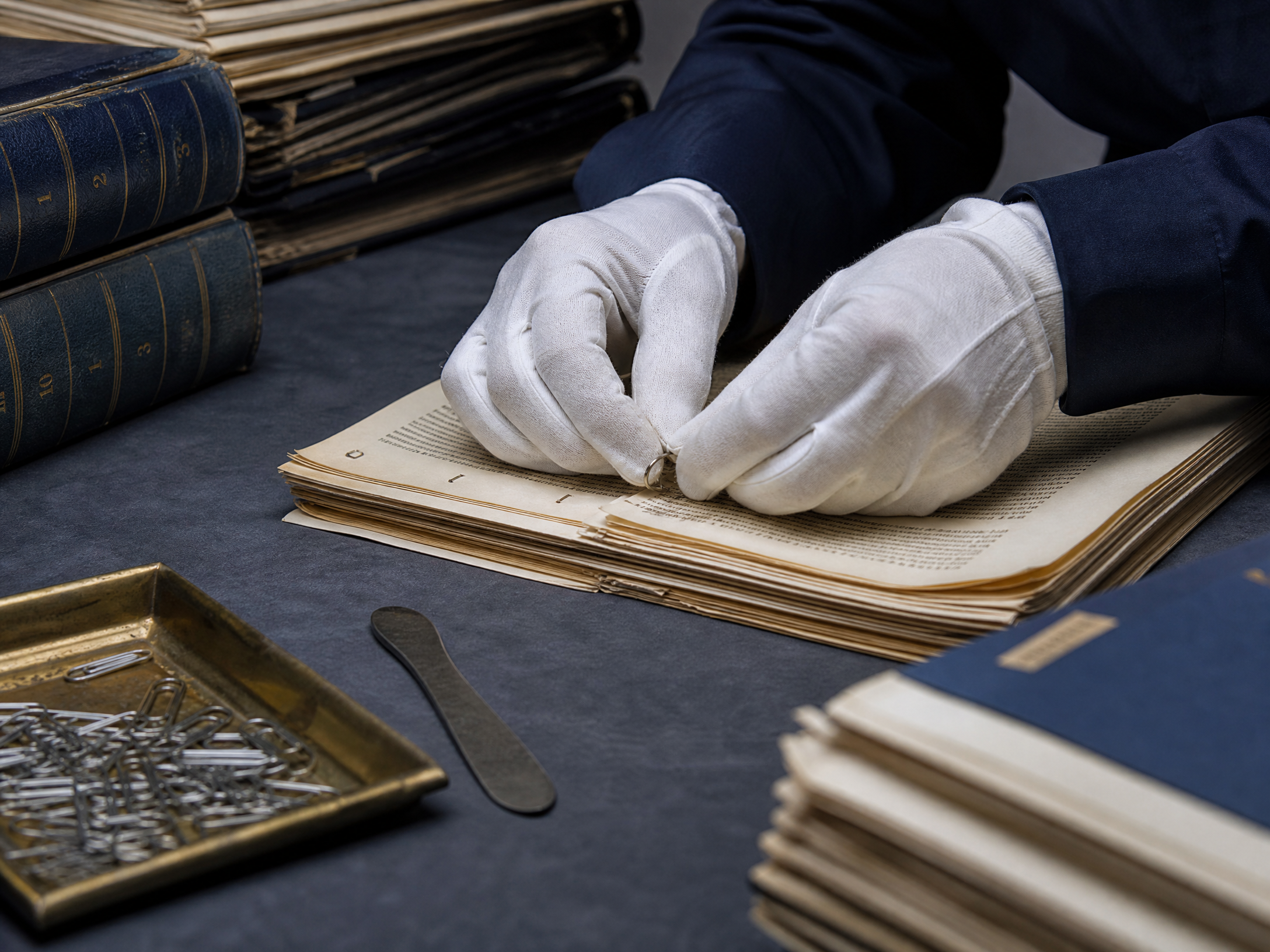
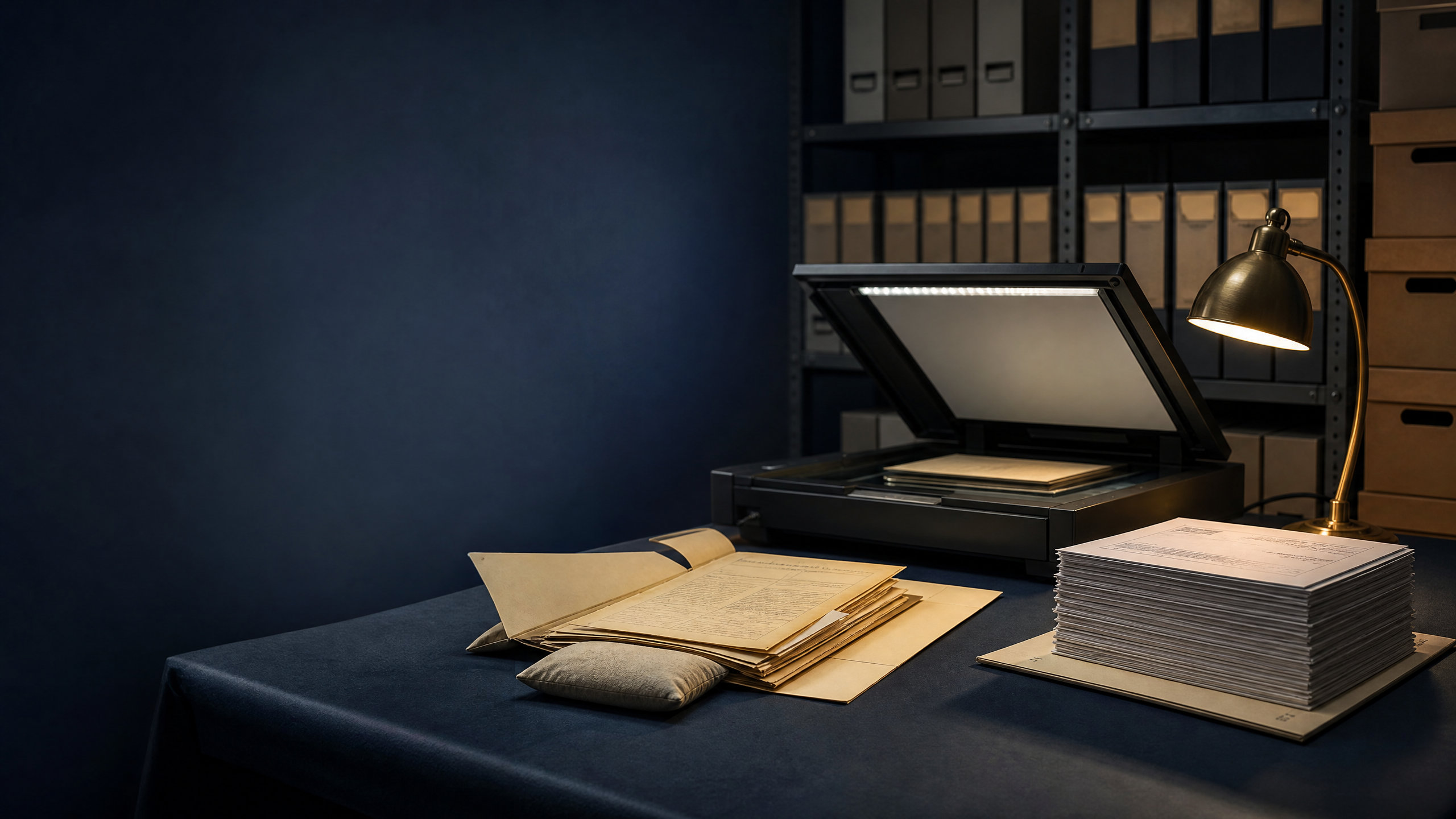
Materials suffering from acid degradation, humidity exposure or handling wear cannot withstand mechanical roller transport. Our preservation team manually positions delicate materials on flatbed capture stations using archival spatulas and weights, ensuring complete image capture without risk of tearing.
Standard sheetfed document feeders exert roller friction that tears brittle paper instantly and smears fragile carbon copies.
Sanctum Technical Handling Specifications:
- ✓Individual flatbed positioning with archival polyester support
- ✓Low-pressure handling by trained document technicians
- ✓High-bit-depth color capture to document physical condition
- ✓Documented exception slips for severely fragmented pages
Oversized Documents & Plans
Architectural drawings, engineering schematics, plat maps and boundary surveys
Oversized drawings contain fine linework, handwritten surveyor notes and scale legends that require high-resolution capture and calibrated stitching. We digitize engineering drawings, land surveys and architectural blueprints at 400 to 600 DPI, delivering searchable, scalable PDF and TIFF files suitable for CAD referencing and GIS ingestion.
Feeding large rolled plans through narrow desktop scanners produces skewed image segments, lost margin legends and distorted scale measurements that compromise engineering and legal utility.
Sanctum Technical Handling Specifications:
- ✓Large-format continuous capture up to 36+ inches wide
- ✓True optical 400–600 DPI resolution for precise linework
- ✓Scale bar calibration preserved in digital header metadata
- ✓Export to layered PDF, TIFF or GIS-ready raster formats
Mixed-Media Collections
Paper files containing CDs, DVDs, USB drives, photographs and audio cassettes
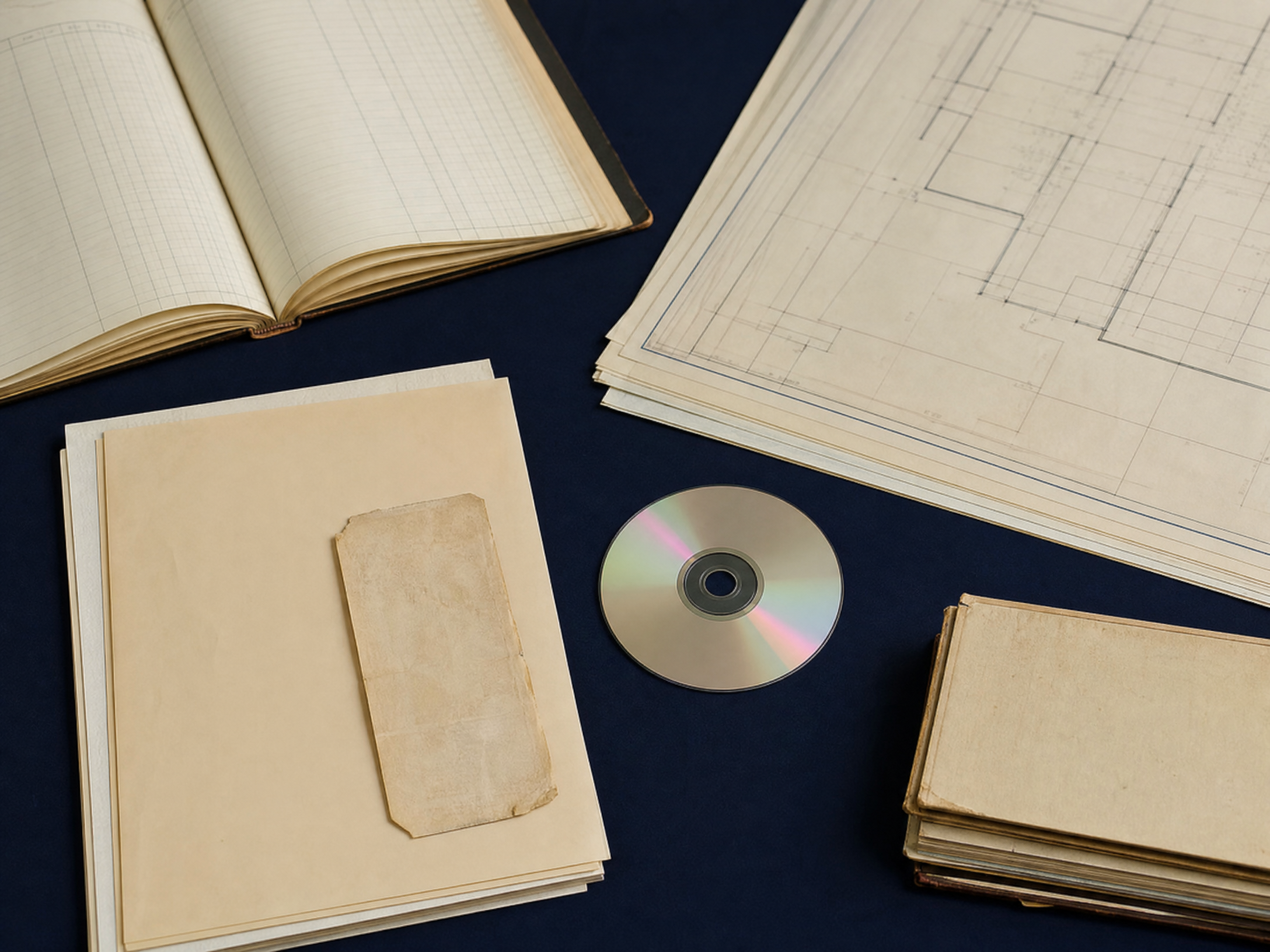
Real-world case files and institutional archives frequently combine paper documents with digital storage media and physical evidence. We provide comprehensive extraction and organization: paper is scanned and OCR'd, optical discs and USB drives are forensically extracted and cataloged and photos are captured at photographic resolution.
Most scanning vendors return physical media untouched or drop disc contents into an unorganized folder with no connection to the surrounding paper records, breaking matter continuity.
Sanctum Technical Handling Specifications:
- ✓Physical media extraction with checksum verification
- ✓File-type sorting (documents, video, audio, databases)
- ✓Integration of media files into matching client matter subfolders
- ✓Damaged disc recovery attempts and disposition logging
Have a collection with non-standard materials?
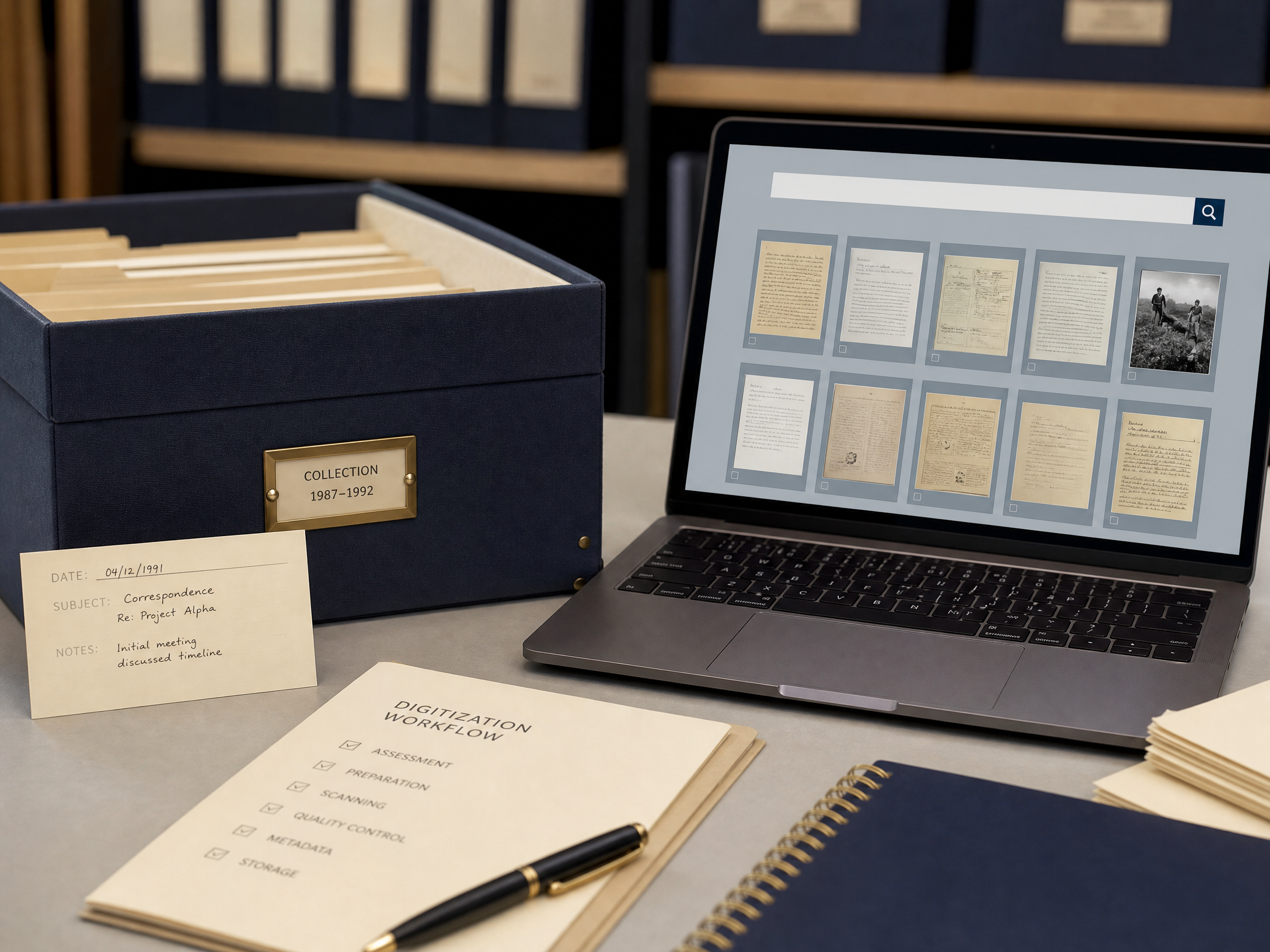
Specialty materials cannot be quoted by simple sheet counts. We evaluate condition, dimensions, fastener types and media formats to deliver a written scope and transparent pricing before work begins.
Request a Collection Assessment